
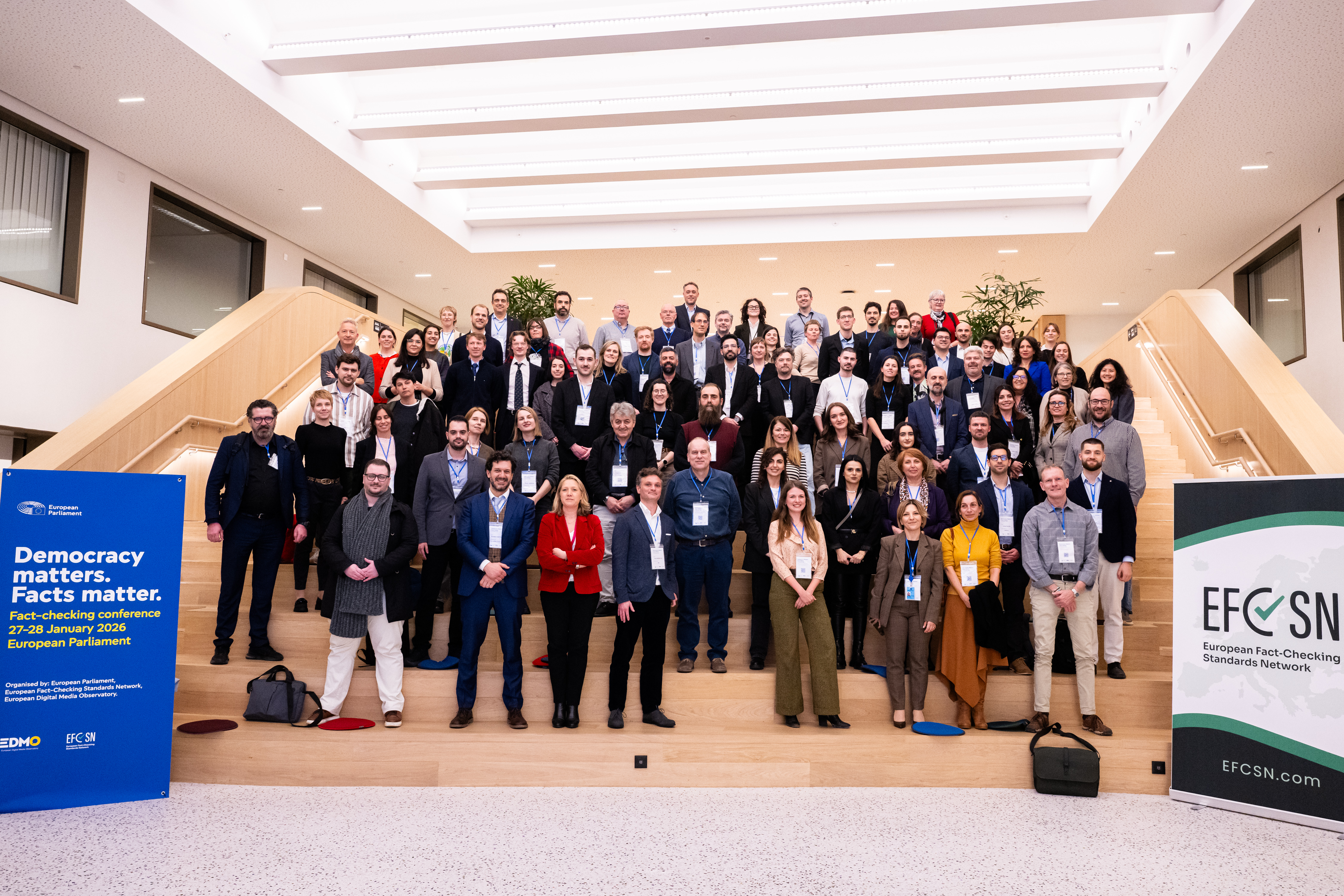
“Democracy matters – Facts matter” conference is co-organized by EFCSN, the European Parliament and EDMO. © European Union 2026 – Source : EP
On January 27-28, 2026, the “Democracy Matters – Facts Matter” conference brought together fact-checkers, policymakers, journalists, and academics, at the European Parliament in Brussels. This fourth-year conference, co-organised by the European Fact-Checking Standards Network (EFCSN), the European Parliament, and European Digital Media Observatory (EDMO), tackled the evolving role of fact-checking in safeguarding information integrity.
Key topics included the practical enforcement of the Digital Services Act (DSA) and the impact of AI on media literacy. Fact-checkers, media institutions, and civil society must counter both foreign interference and domestic extremism.
A Unified Front Across the Political Spectrum

EP Vice-President Sabine Verheyen, Chair of the Bureau Working Group on Communication gave her opening remarks. © European Union 2026 – Source : EP
Disinformation is recognized as an imminent threat to Europe. The conference underscored a cross-partisan consensus: information integrity is no longer a niche concern, but a strategic priority. EP Vice-President Sabine Verheyen (EPP, Germany) compared the information environment to the air we breathe: “We are living in times of crisis, when democracy is challenged not only from outside, but increasingly from within. Just as humans need air to breathe, we require an information environment grounded in facts—an atmosphere where citizens can access verified information, allowing society to function and democracy to endure.“
EP Vice-President Roberts Zīle (ECR, Latvia) highlighted the reality of relentless foreign interference. He called for a united European front against external manipulation, noting that strict political neutrality is essential for fact-checkers to retain public trust in this polarized climate.
MEP Mika Aaltola (EPP, Finland) added that autocratic regimes now prioritize destabilization over traditional espionage, targeting not just politics but increasingly the business sector.
Fact-Checking as Essential Infrastructure

EFCSN Chair Clara Jiménez Cruz’s opening remarks. © European Union 2026 – Source : EP
Fact-checking has matured from debunking to democratic infrastructure. Clara Jiménez Cruz, Chair of the EFCSN, underscored that the community’s contribution is now a permanent component of Europe’s democratic architecture: “Fact-checkers do more than correct false claims. They document manipulation patterns, they track coordinated networks, and produce evidence that brings transparency to the information space, helping policymakers and regulators distinguish legitimate political disagreement from organized manipulation.”
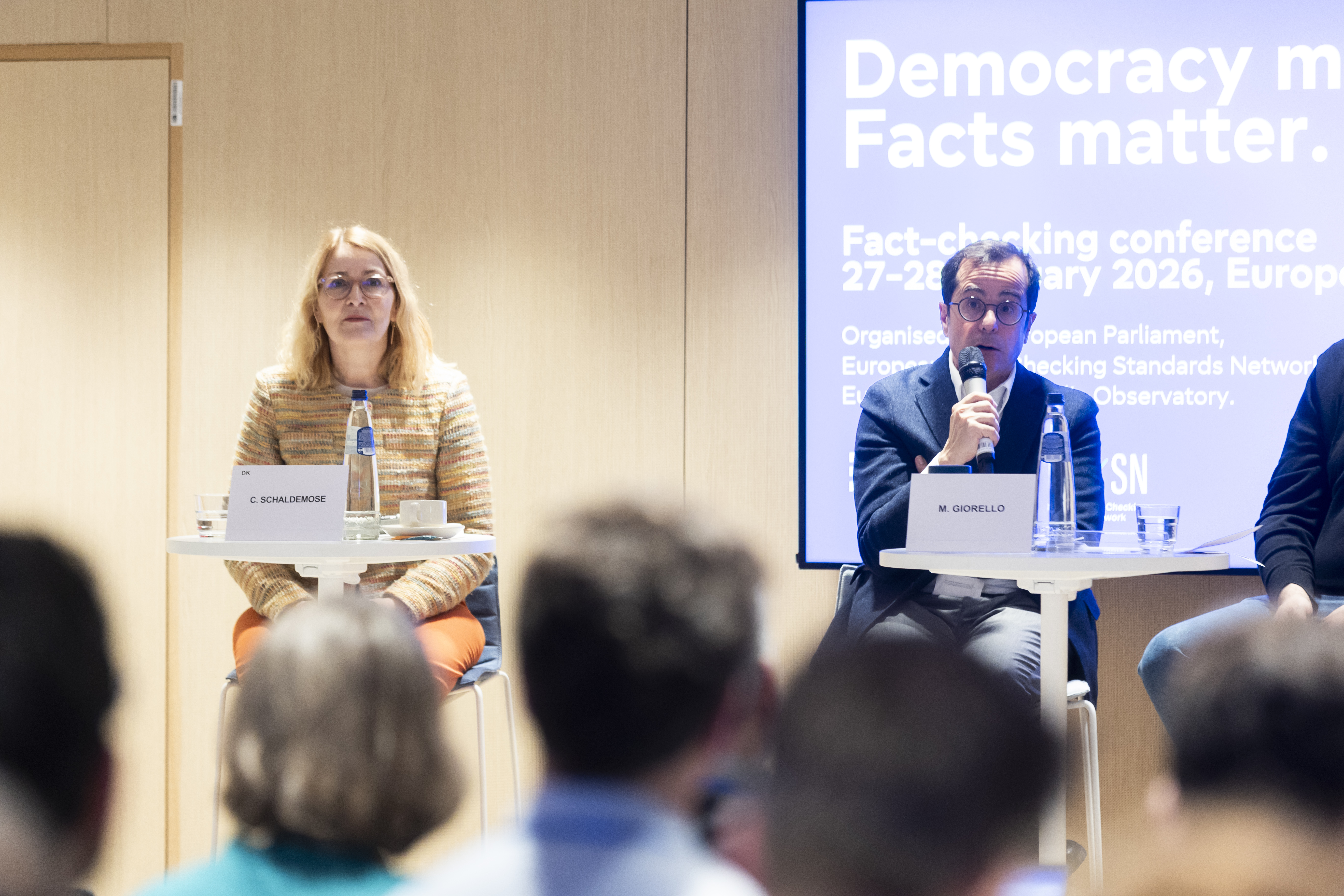
In the panel “Enforcement of the DSA amid rising tensions”, EP Vice-President Christel Schaldemose, Chair of the Working Group on Digital Services Act Implementation(left) and Marco Giorello, Head of Unit, DG CNECT(right), discuss the current status of the DSA. © European Union 202 – Source : EP
This role is central to the Digital Services Act (DSA). EP Vice-President Christel Schaldemose (S&D, Denmark), Chair of the Working Group on DSA Implementation, emphasized that the law is not about censorship—it holds platforms accountable while keeping politics at arm’s length.
Carlos Hernández-Echevarría (EFCSN Policy Task Force) argued that protecting information integrity means adding context, not removing content. By providing labels and data, fact-checkers respect the public’s ability to judge for themselves and enhance freedom of speech. Under this model, the Digital Services Act (DSA) becomes a tool for transparency and informed public discourse.
Marco Giorello (DG CNECT, European Commission) noted that the DSA’s success relies on documenting systemic failures, not just debunking individual posts. He highlighted the forensic value of fact-checkers’ evidence as a tool for holding platforms accountable for the systemic risks they might pose.
Navigating the AI Revolution and Media Literacy
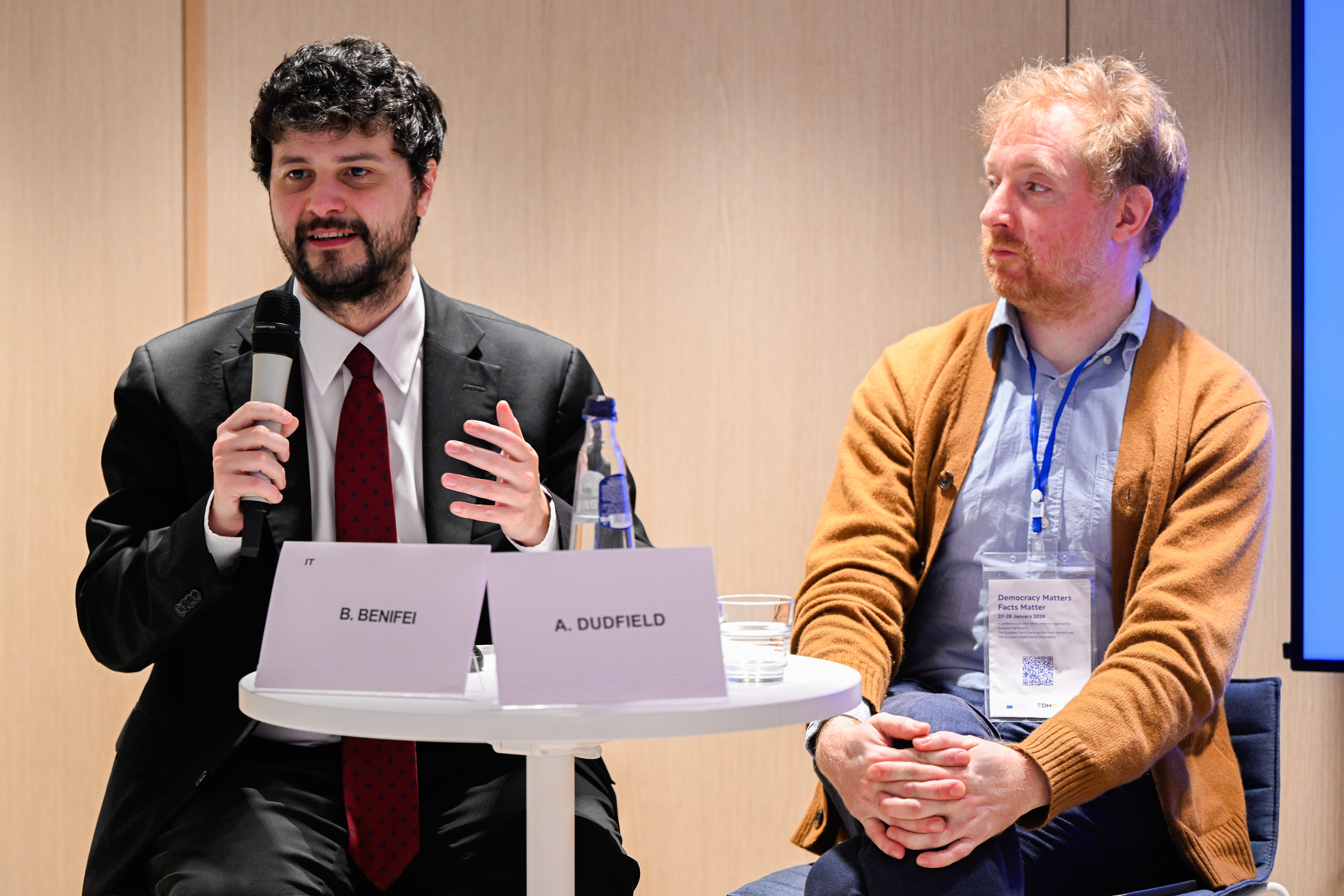
MEP Brando Benifei, EP rapporteur AI Act (Left) and Andrew Dudfield, Head of AI, Full Fact (Right) © European Union 2026 – Source : EP
The influence of AI-generated content was a primary concern, specifically how chatbots can spread incorrect information with total confidence. MEP Brando Benifei (S&D, Italy), rapporteur for the AI Act, explained that while transparency is now legally required, these rules mean little without consistent enforcement.
He argued that, aside from existing protections against illegal content like terrorism or child safety, the law must treat the “Right to Information” and the protection of democracy as specific risk. Benifei pointed out that tech giants often delay safety improvements until a crisis forces their hand, making it essential for regulators to hold these powerful entities accountable before harm occurs.
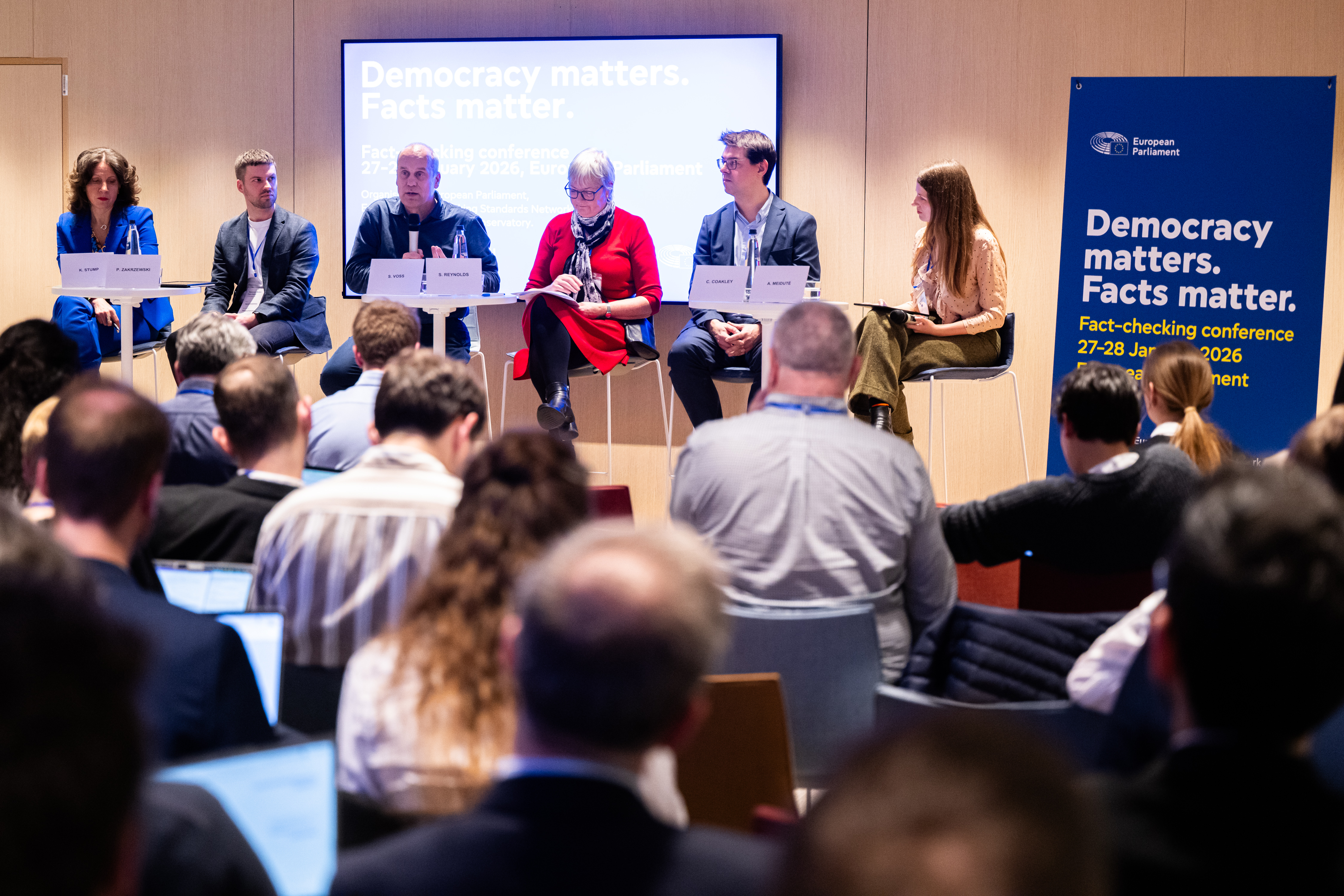
The Panel covering Media and AI Literacy. © European Union 2026 – Source : EP
Focusing on the societal resilience pillar of the European Democracy Shield, Krisztina Stump (DG CNECT, European Commission) clarified that the European Commission will support established networks like the independent EFCSN and EDMO instead of creating new structures. She further identified media literacy as a strategic priority, focusing on vulnerable regions and younger demographics who consume news via social media influencers.
MEP Tiemo Wölken (S&D, Germany) warned of “SNAPs”(Strategic Notices Against Public Participation), the AI-driven legal harassment designed to silence critics. Judicial systems, he said, must learn to distinguish legitimate claims from these automated attacks.
Moving Toward Permanent Support for Media Pluralism
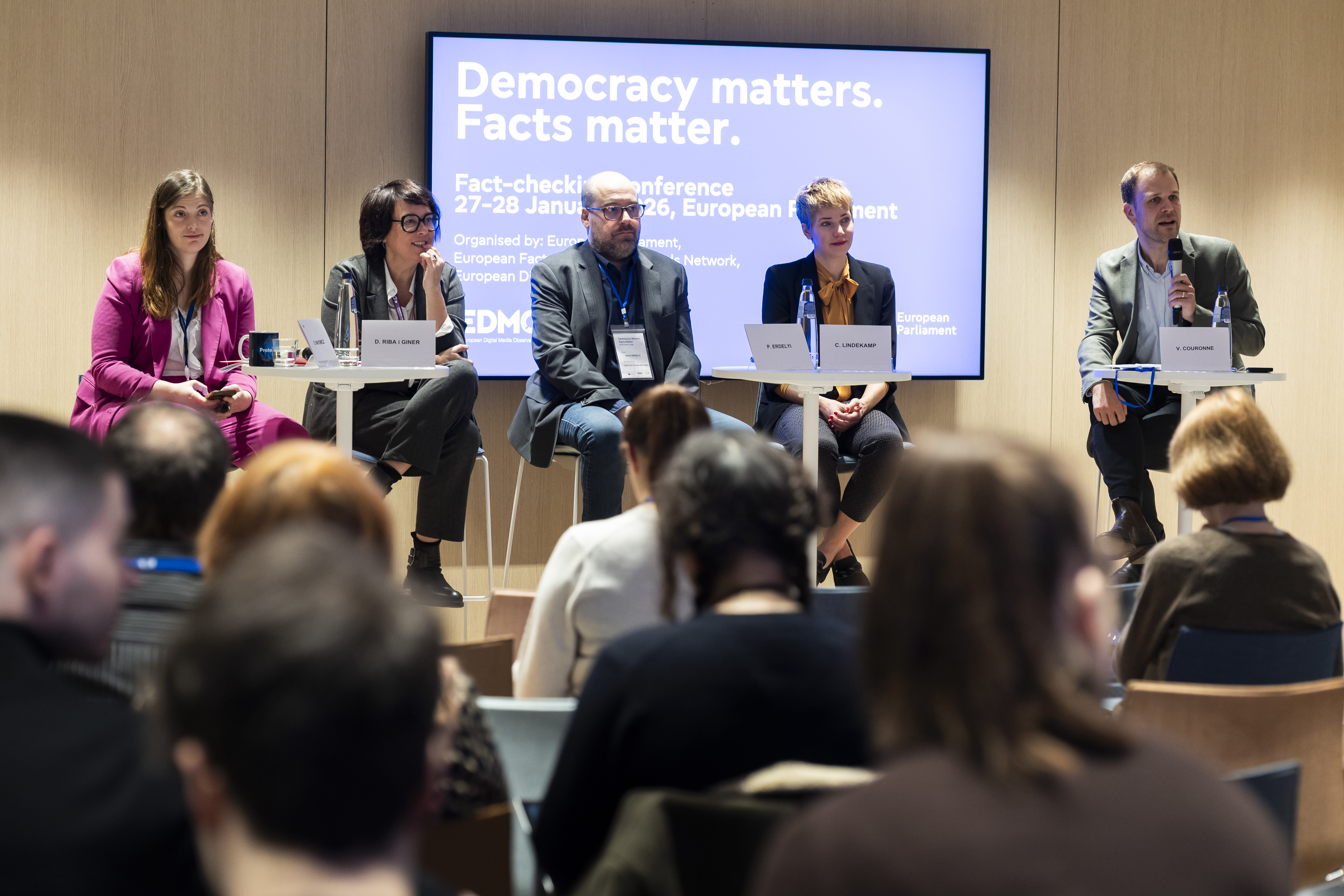
The panel Towards a sustainable funding model, with (Left to right)MEP Emma Rafowicz and MEP Diana Riba i Giner, rappoteur & shadow rapporteur ‘AgoraEU’ programme 2028– 2034, Peter Erdelyi, Founding Director, Center for Sustainable Media, Caroline Lindekamp, Director Fact-Checking, CORRECTIV, and Vincent Couronne, Les Surligneurs & EFCSN Governance Body. © European Union 2026 – Source : EP
Beyond policy and technology, the conference addressed the financial sustainability of the information space. Stakeholders stressed the need for clear earmarks within the EU’s next Multi-annual Financial Framework (MFF) to ensure the media sector receives strategic support. MEP Emma Rafowicz (S&D, France) emphasized that “culture and information integrity are strategic assets for democracy,” arguing that even in geopolitical tension, funding essential democratic infrastructure cannot be sidelined by other spending priorities.
The fact-checking community emphasized that protecting pluralism requires moving away from unpredictable, short-term grants toward stable, long-term funding. Smaller, independent organizations and specialized fact-checkers cannot sustain their work under constant financial uncertainty. Using intermediary funding models is essential to get resources to local groups that actually build trust on the ground and provide the diverse perspectives a healthy democracy needs.
Takeaways:
The 2026 “Democracy Matters – Facts Matter” conference concluded with a clear roadmap for the coming years:
- Practical Enforcement: The focus is now on how the DSA actually works in practice. This means working directly with regulators to ensure platforms are held accountable for the real-world impact of their systems, moving beyond the text of the law to its daily application.
- Reliable Support: Media diversity needs reliable funding. Moving toward long-term support through programs like AgoraEU, with fixed allocations to ensure predictability for the sector is essential to keep these organizations running consistently.
- Addressing Internal Threats: While foreign interference gets the headlines, local disinformation is just as dangerous. It needs to be treated with the same level of urgency as external threats.
