Fact-checkers are frequently the targets of attacks and harassment as they speak truth to power. The fact-checking community has been repeatedly harassed: individual fact-checkers and organisations have faced threats, vandalised offices, SLAPPs, and coordinated online hate campaigns designed to censor or cancel their work.
In response, the consortium comprised of the European Fact-Checking Standards Network (EFCSN), together with its members Faktograf, Pagella Politica, Fact Review, FactCheck Cyprus, and Greece Fact Check, has initiated a protection scheme with the support of the European Union.
The primary aim of this scheme is to provide direct, rapid support to fact-checkers in need (e.g. due to online harassment campaigns, hacking attempts, vandalisation of office spaces, threats of physical violence, physical attacks, threats of imprisonment or lawsuits, SLAPPs). Those facing harassment or requiring assistance for their psychological, physical, online or legal safety may submit requests for support under this call. All submissions will be handled with the utmost security and processed as quickly as possible to provide aid to those affected.
Support and Eligible Activities
Fact-checking organisations can request support for the following:
- Psychological Support: counselling, burnout prevention, and specialised training. Please note that costs for general staff wellbeing not linked to a specific incident or harassment situation are not eligible.
- Legal Aid: defence against defamation, harassment, cyber and physical violence, SLAPP suits, copyright disputes, etc. Please note that legal costs related to commercial disputes, employment matters, or issues unrelated to fact-checking activities are not eligible.
- Safe Workspace: this may include installation of security systems, purchase or rental of security equipment, rental of a secure workspace, or costs to enable staff to work remotely during a period of risk. For fact-checkers, the workspace is understood as the reporting assignment itself and the physical space immediately surrounding it.
- Emergency Relocation: transport, temporary housing, crisis coordination for teams in danger, etc.
- Cybersecurity: upgrades for encryption, security tools, and risk assessments, etc. Please note that general IT infrastructure upgrades not linked to a specific security threat or incident are not eligible.
Eligibility Criteria
To be eligible for funding, applicants must meet the following requirements:
- Legal entity: applicants must be a legal entity, whether for-profit or non-profit.
- Certification: applicants must be EFCSN certified fact-checking organisations or fact-checking organisations that can demonstrate they respect in practice the European Code of Standards for Independent Fact-Checking Organisations.
- Location: organisations must be based in the European Union or DEP-associated countries (see this document for the most up-to-date list).
- Single applicants: this call is intended for single applicants, i.e. consortia of organisations cannot apply for this call.
Budget, Funding, Payment Terms, Grant Duration
- Total Call Budget: €340,169
- Maximum Grant Amount: €20,000 per support request; in exceptional cases (e.g. relocation of a large team), grants can be up to €40,000. Such requests must be reasoned in detail and must be approved by the EFCSN Governance Body in addition to the standard selection procedure outlined below.
- Funding Rate: 50%
- Form of Grant: lump sums
- Number of Grants: ~17
- Payment Structure: 75% upon approval of request, 25% following the approval of the final report.
- Exact amount must be calculated using this template table.
- List of eligible costs:
- Direct costs must be directly related to the implementation of the requested support and fall under one of the following categories (although the examples below are not exhaustive):
- A. Psychological Support: costs related to mental health, wellbeing support, physical checkups related to long-lasting stress, including counselling sessions, burnout prevention activities, and specialised trauma training provided by qualified professionals.
- B. Legal Aid: costs related to legal support services, including legal counsel or lawyer fees, court or filing fees, legal document translation, notary services, and other directly related legal expenses.
- C. Physical Safety: costs related to ensuring the physical safety of staff or premises, including security system installation, security equipment purchase or rental, secure workspace rental, remote work setup costs, and related services.
- D. Emergency Relocation: costs related to urgent relocation and crisis response, including transport, temporary accommodation, crisis coordination services, subsistence costs during relocation, and related support.
- E. Cybersecurity: costs related to digital security and protection, including security software or tool licences, cybersecurity audits or risk assessments, secure hardware (e.g. encrypted devices), implementation and setup costs, and related services.
- Direct costs must be directly related to the implementation of the requested support and fall under one of the following categories (although the examples below are not exhaustive):
- Retroactive costs: if a grant is approved, costs are eligible from the time of application submission.
- Indirect / Administrative costs: these are capped at 10% of total direct costs.
- Max. Grant Duration: 12 months
- Rolling basis: this call is open on a rolling basis from 2 September 2026 until 31 May 2028 (or until funds are depleted).
Selection Procedure
The evaluation will be conducted in two steps:
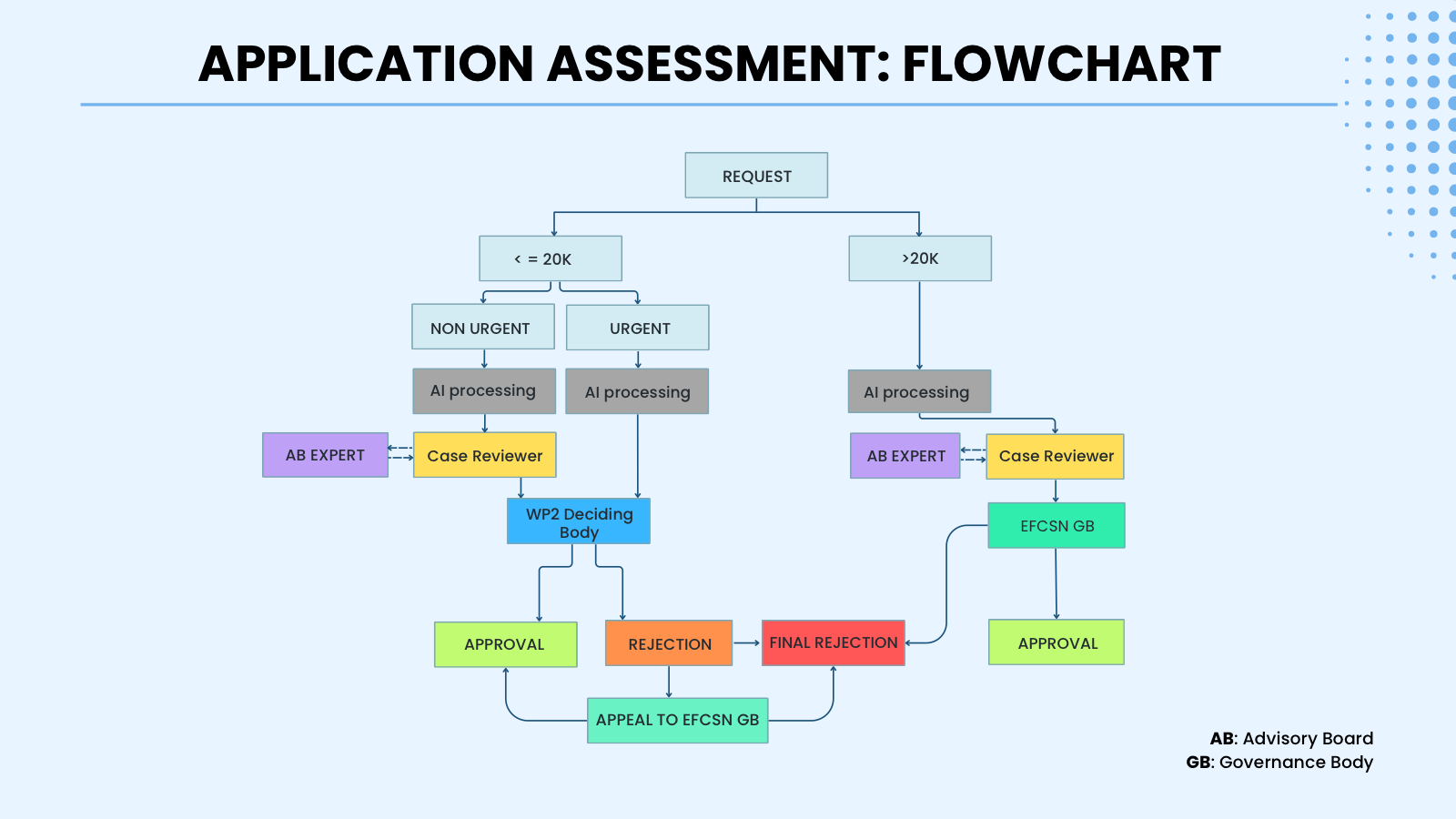
Phase 1: AI Processing. The application platform will automatically review submitted applications to ensure that all required information has been provided and that applicants meet the basic eligibility criteria.
Phase 2: Expert Evaluation. Requests will be evaluated by the consortium experts based on need, urgency, regional vulnerability, and the applicant’s capacity to absorb the support. Consortium experts may request additional advice from a multidisciplinary group of experts, comprising the Protection Scheme Advisory Board, and escalate particularly delicate decisions to the EFCSN Governance Body. EFCSN will oversee the process, ensuring transparency, financial safeguards, and equitable distribution. Applications will be assessed against the award criteria outlined below.
The evaluation is conducted in several steps, depending on the amount and urgency of the request, as shown below:
The main criteria for evaluating the requests are:
| Category | Description | Max. points |
|---|---|---|
| Need | Clear evidence of an acute operational or financial gap directly tied to the emergency situation. Financial statements and other documents may be requested as evidence. | 10 |
| Urgency | Time-sensitive circumstances where delayed support would meaningfully worsen the outcome. | 10 |
| Regional Vulnerability | Context of operating environment: political, economic, or press freedom constraints that amplify risk. | 10 |
| Absorptive Capacity | Organisational ability to receive, manage, and account for the funds in a timely manner. | 10 |
How to Apply and Timeline
To apply, please submit your request through the application platform. Requests for urgent support will be processed within 48 hours; other requests will be processed within 5 working days.
Reporting
An outcome report (financial and narrative) is expected from all grant recipients.
Transparency Notice
This call has also been published on the EU Funding & Tenders Portal. Funding granted through this call will be disclosed on efcsn.com/funding-opportunities. Disclosure will cover the name of the receiving organisation, amount, and grant duration.
NB! If a grant recipient operates in a high-risk environment or handles sensitive data, they may request that their identity remains confidential during the implementation phase and be disclosed after the end of the funding cycle.
Questions?
Please send questions about this call to [email protected].

Funded by the European Union. Views and opinions expressed are however those of the author(s) only and do not necessarily reflect those of the European Union or European Health and Digital Executive Agency (HADEA). Neither the European Union nor the granting authority can be held responsible for them.