© Delfi / Josvydas Elinskas
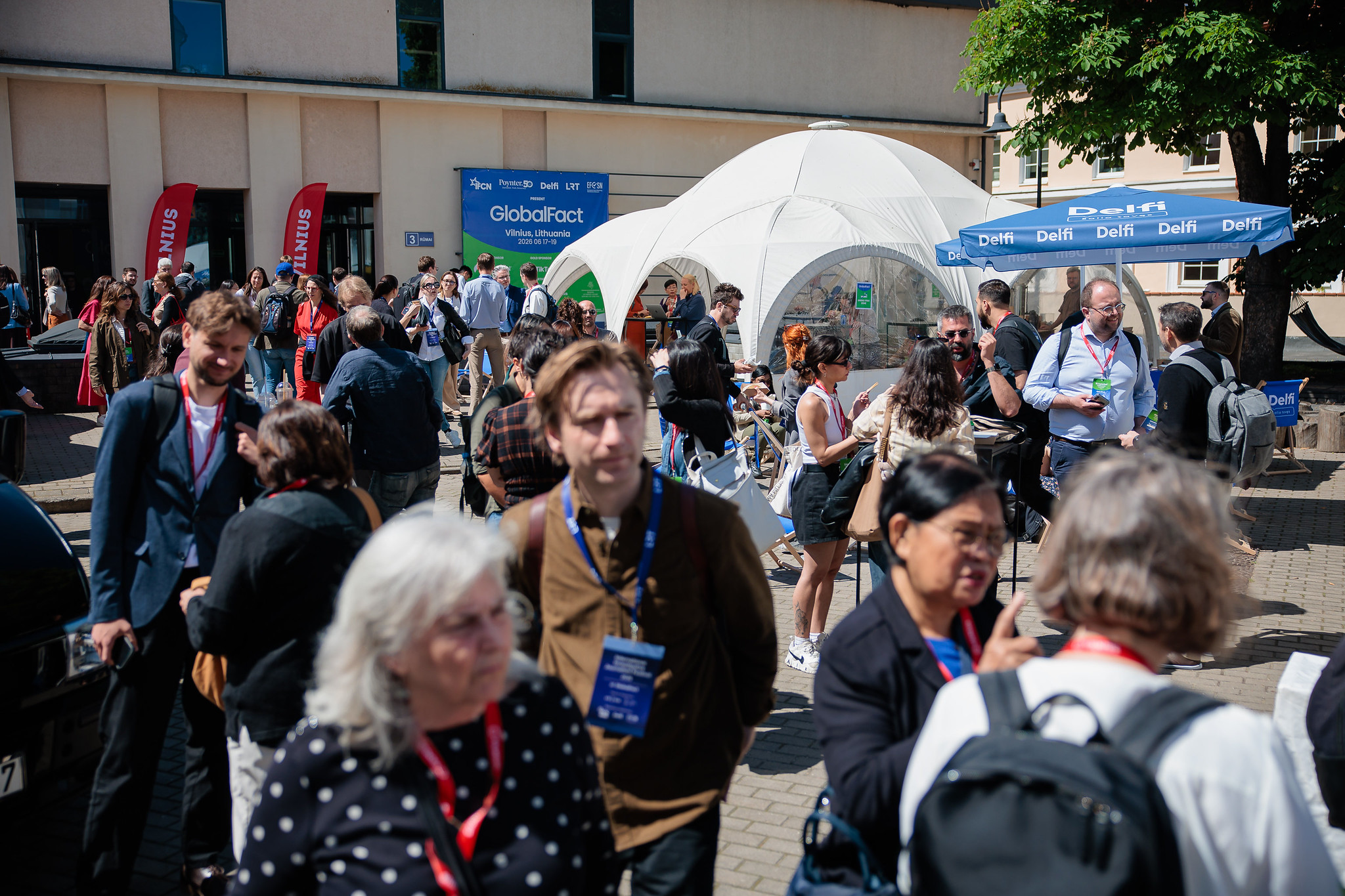
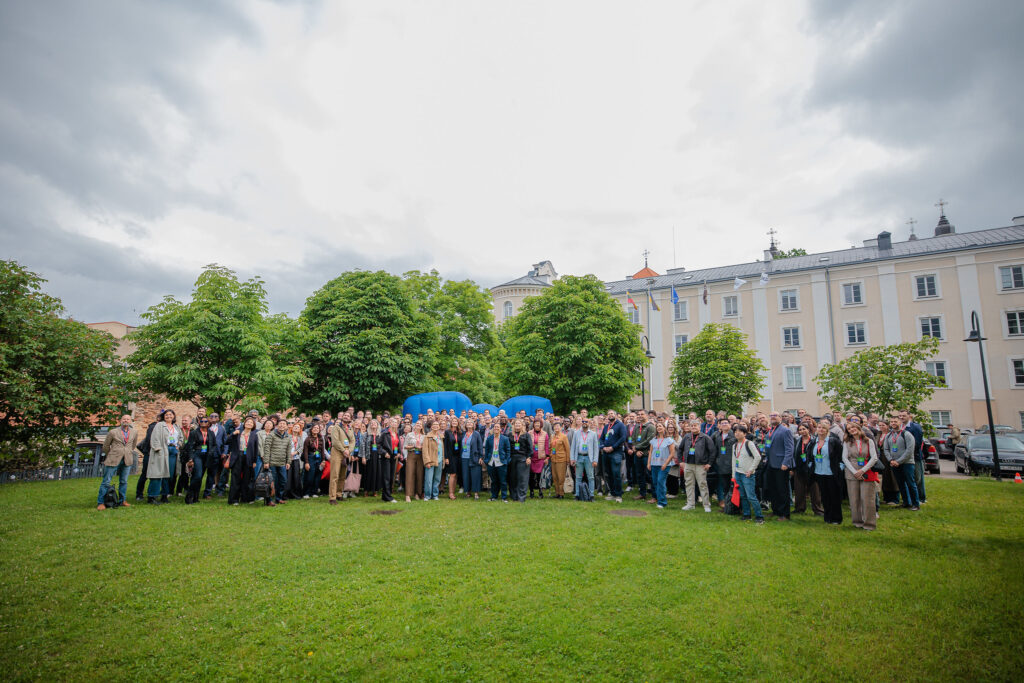
In Vilnius, a city where the government treats disinformation as a matter of national defense, more than 300 fact-checkers spent three days confronting the two forces reshaping their profession: artificial intelligence and vanishing funding. From 17 to 19 June 2026, journalists and researchers gathered in Lithuania for GlobalFact 2026, the world’s largest annual fact-checking conference — co-organized by EFCSN alongside the International Fact-Checking Network (IFCN), Delfi, and LRT, and the first time the conference came to the Baltics.
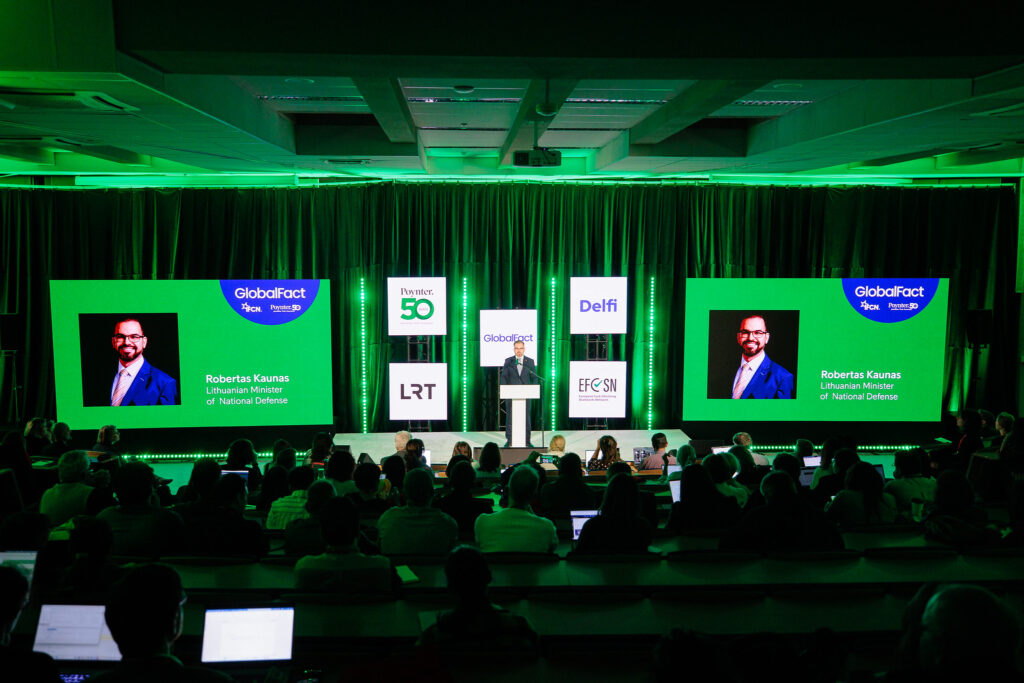
Minister of National Defense of Lithuania Robertas Kaunas © Delfi / Josvydas Elinskas
A conference on the frontline
The conference took place in Vilnius, a city that deals with Russian information manipulation daily, where the government treats this as a matter of national defense. In the opening remark, Minister of National Defense Robertas Kaunas told attendees that Lithuania now considers cognitive warfare a domain of conflict on par with land, sea, air, space and cyber. Throughout the conference, journalists from Estonia, Ukraine, Moldova, Poland and Finland shared how they investigate Russian influence operations, from infiltrating paid protest networks to getting recruited as saboteurs through Telegram channels. The message was the same everywhere: this is a cross-border problem, and it needs a cross-border response.
“What is tried against Lithuania today may reach any country tomorrow,” Kaunas warned.
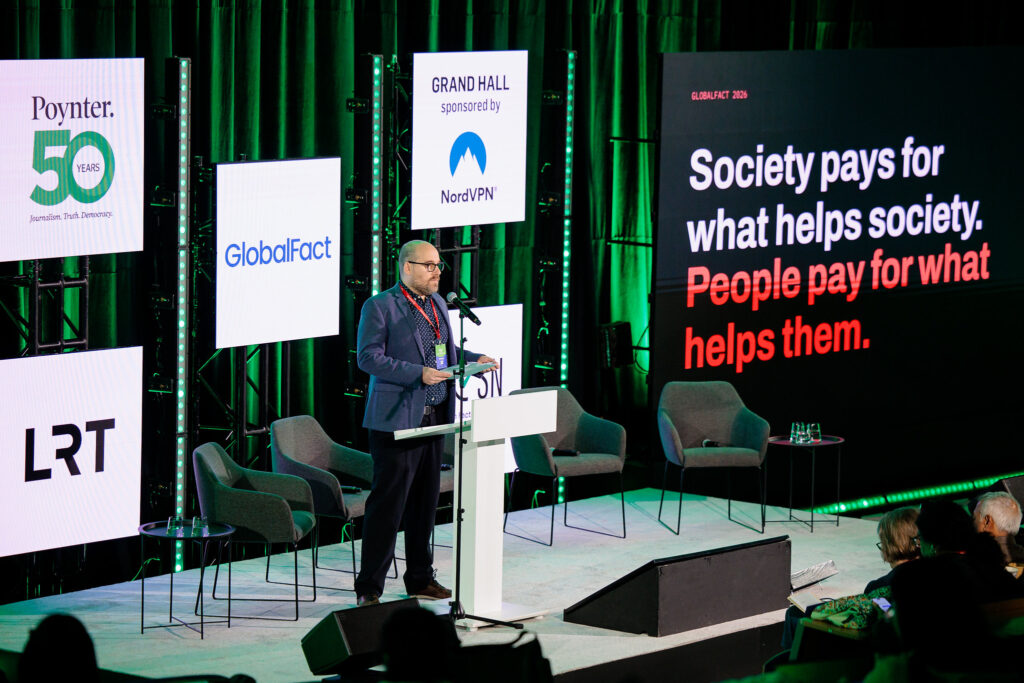
Peter Erdelyi as a keynote speaker on stage of GlobalFact13© Delfi / Josvydas Elinskas
Who pays for the public good?
The financial crisis gripping the fact-checking sector has become impossible to ignore. Three quarters of the fact-checkers surveyed by the IFCN describe their position as financially vulnerable or in crisis, following platforms’ withdrawal from third-party fact-checking programs. Addressing this existential threat in his keynote address, Peter Erdelyi of the Center for Sustainable Media argued that fact-checkers have long treated their work as a public good, which makes it hard to monetize, and urged organizations to diversify their revenue streams, moving beyond traditional funding to design specialized products tailored to specific audiences, ranging from premium paid newsletters for individual subscribers to corporate misinformation monitoring services. As Erdelyi pointed out, the ultimate law of media survival is simple: ‘Society pays for what helps society. People pay for what helps them.‘ To weather this financial winter, fact-checking organizations must learn to translate public good into direct, individual value.
© Delfi / Julius Kalinskas
AI on both sides of the fight
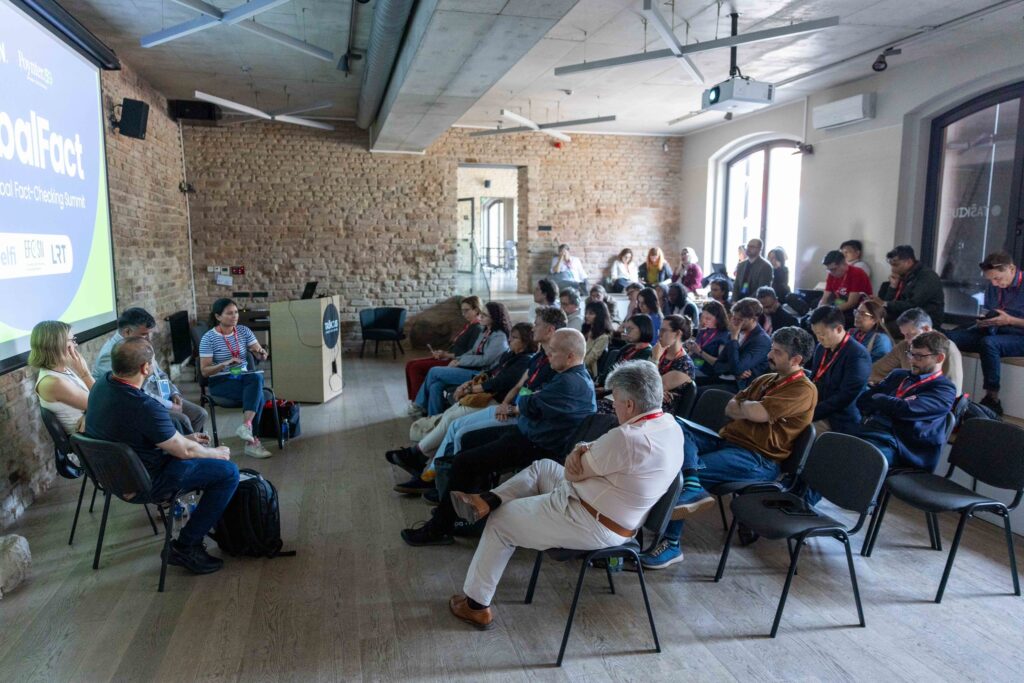
AI ran through almost every session, as a threat, tool and object of study. Panels covered the manipulation of chatbots through what researchers call LLM poisoning, where bad actors flood the web with false content hoping AI models will repeat it, and new efforts to audit how models handle politically contested information. EFCSN member Full Fact presented the AI Trust Benchmark it is developing, a framework for testing whether AI assistants actually give people accurate information.
AI is also rewriting the fraud playbook. On a panel about online scams, fact-checkers from Germany, India, Iraq and Mongolia described schemes ranging from AI generated celebrity investment videos to so-called digital arrests, with estimated losses in India alone reaching 48 billion dollars in a year.
Solidarity, this year’s theme
If one theme ran through the whole conference, it was solidarity. Keynote speaker Nina Jankowicz put the word at the center of her address, and the program showed it in practice, nowhere more than in Europe, where collaborations now cross borders as routinely as the campaigns they counter.
Ukrainian journalist Anna Myroniuk described teaming up with Latvia’s Re:Baltica to investigate a Russian historian based in Riga, a story that needed a local reporter to press the Latvian authorities. Holger Roonemaa of Delfi Estonia explained that the coordinated campaigns his team tracks no longer stop at the Baltics, so neither does the reporting: what matters in Estonia can matter just as much in Norway, Sweden, Germany or France. Denmark’s TjekDet worked with Politiken, Bellingcat and Canada’s CBC to unmask the person behind one of the world’s largest deepfake pornography platforms. And across panels, cross border investigations, co-publishing and shared resources came up again and again as what Europe needs to counter disinformation at the scale it now operates. In response to the increasingly coordinated efforts of illicit networks, it is imperative that we enhance our collaborative framework and collective intelligence sharing.
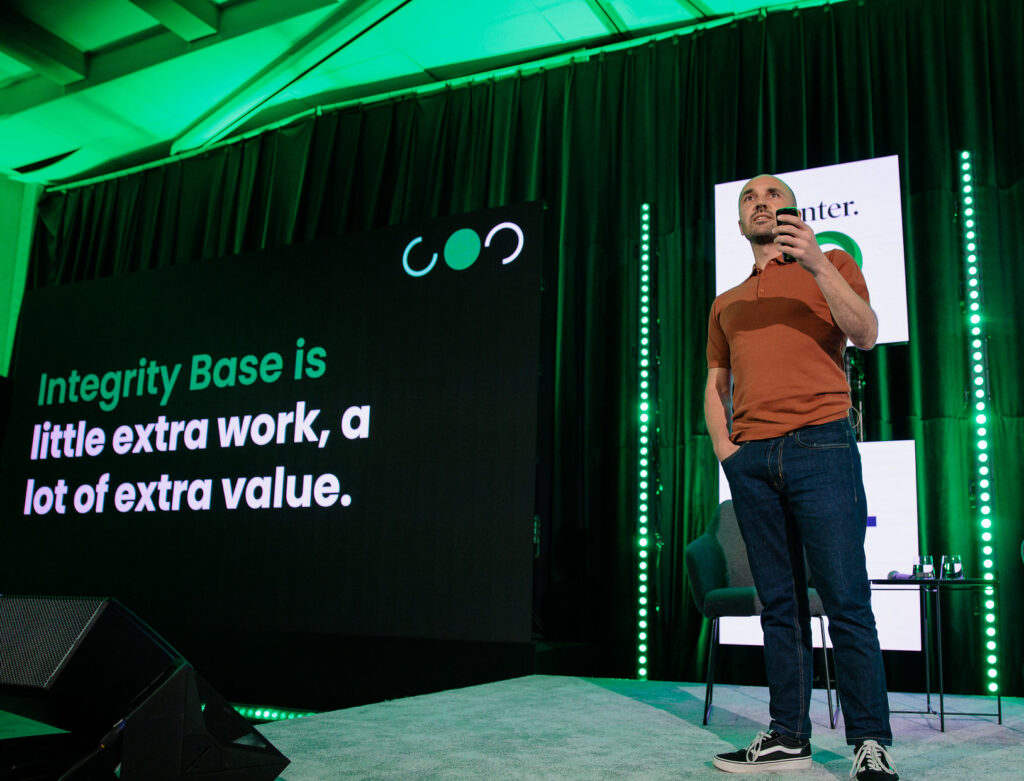
© Delfi / Josvydas Elinskas
Introducing Integrity Base
That is exactly the thinking behind the two projects the EFCSN brought to the main stage. EFCSN Coordinator Stephan Mündges introduced Integrity Base, a shared database of fact-checks, claims and disinformation appearances, starting in Europe and open to the wider fact-checking community. When a fact-checker publishes an article, it is automatically ingested into the database and annotated by AI, and anything the system is unsure about goes back to the fact-checker for review. The result is structured, verified data that makes it easier to spot recurring narratives across borders and languages, and the data stays with the organizations that create it. It is expected to go live this autumn.
At the Show and Tell Showcase, EFCSN presented Prebunking at Scale, our project to address false claims and narratives before they gain widespread traction. The project pairs a monitoring and matching system, which analyzes public social media content in more than 30 languages to identify emerging narratives, with prebunking content produced by EFCSN members. Members are already putting it to work: Demagog in Poland used the tool to prebunk alarmist narratives framing routine military qualification as war mobilization, while Newtral in Spain tracked how old moon landing hoaxes resurfaced in conspiracy theories around the Artemis II mission.
EFCSN members take home three of four awards
The 2026 Global Fact-Checking Awards brought good news for the network: three of the four winners are EFCSN members. TjekDet won the Collaboration award for unmasking the person behind one of the world’s largest deepfake pornography platforms, EFE Verifica won the Creative Format award for “Fake News, Real Victims,” and Pravda won the Impact award for an investigation into pseudomedical marketing claims in Poland.
Vilnius has made it clearer than ever: our impact lies in our unity. We return to our work with a shared vision and the certainty that we are stronger together. A heartfelt thank you to every member and fact-checker who catalyzed discussions and drove our collective mission forward. See you all next year at Global Fact 14 with more vigorous results of collaboration, the journey continues.