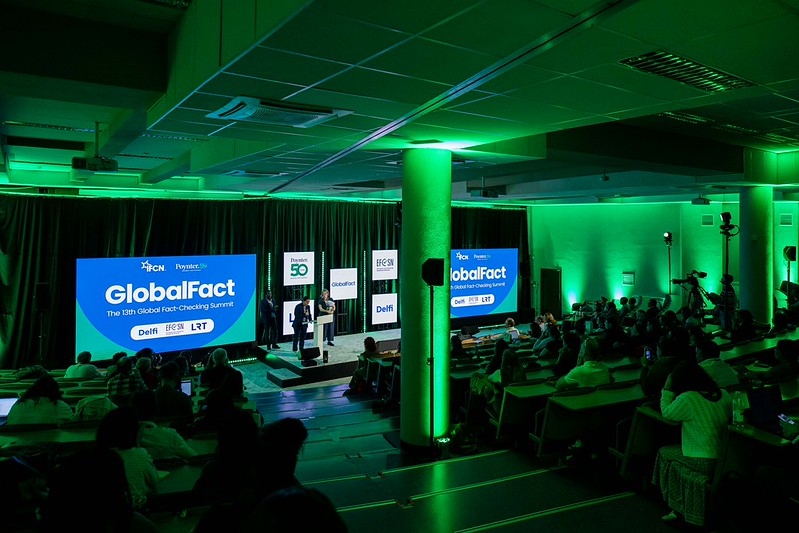
GlobalFact is the International Fact-Checking Network’s annual conference, and each year it closes with an awards ceremony recognising the most impactful fact-checking work from around the world. This year, EFCSN co-organised the conference alongside IFCN, Delfi and LRT, bringing together fact-checkers, researchers and policymakers in Vilnius, Lithuania from 17 to 19 June.
Six EFCSN members made it to the finalist stage across four categories — and three of them won. Here’s what they worked on.
The winners
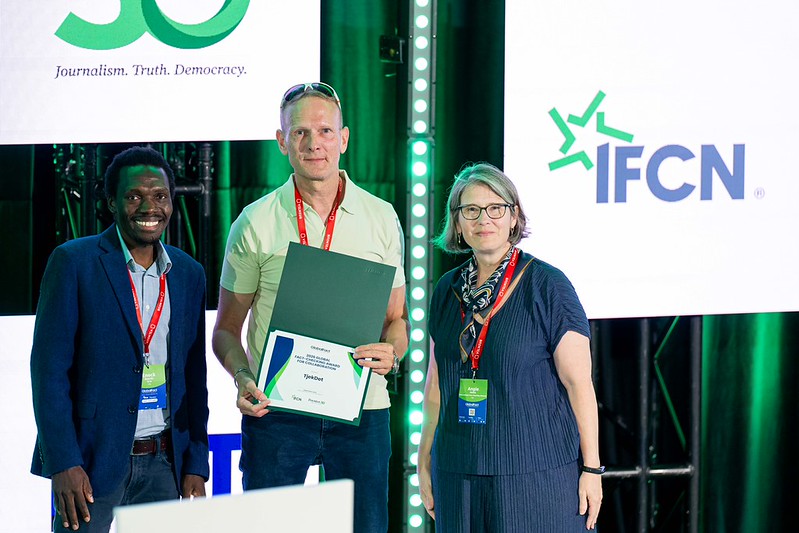
TjekDet (Denmark) won the Global Fact-Checking Award for Collaboration at GlobalFact 2026 for their investigation into deepfake pornography and AI-enabled gender-based violence, conducted together with CBC, Bellingcat and Politiken.
TjekDet (Denmark) — Award for Collaboration
TjekDet, together with CBC, Bellingcat and Politiken, investigated the growing harm of deepfake pornography and AI-enabled gender-based violence. Using open-source intelligence techniques, the team traced one of the world’s largest deepfake pornography platforms from Denmark back to its owner in Canada, exposing the ecosystem behind the abuse. The investigation contributed directly to the platform being shut down.
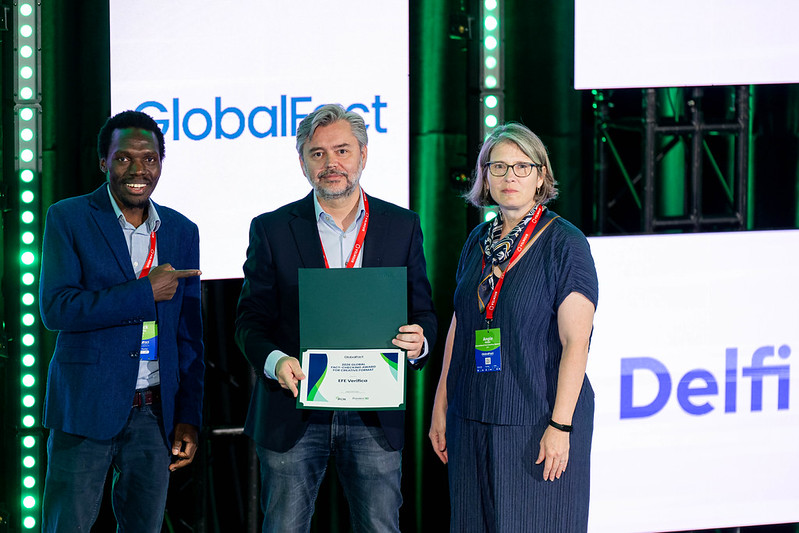
EFE Verifica (Spain) won the Global Fact-Checking Award for Creative Format at GlobalFact 2026 for “Fake News, Real Victims,” a multimedia series following 10 individuals across four continents whose lives were affected by disinformation.
EFE Verifica (Spain) — Award for Creative Format
“Fake News, Real Victims” put people at the centre of disinformation coverage. Rather than focusing on the false claims themselves, EFE Verifica followed 10 individuals across four continents whose lives had been affected by conspiracy theories and false narratives, and told their stories through articles, videos and a podcast.
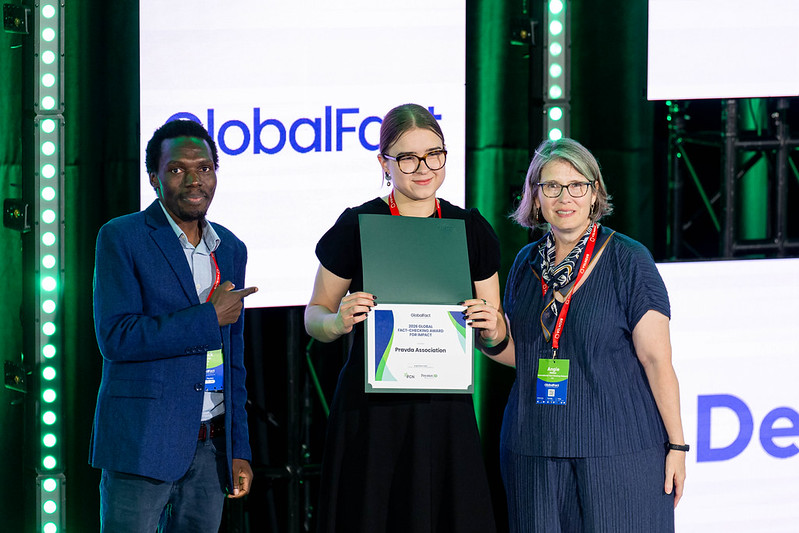
Stowarzyszenie Pravda (Poland) won the Global Fact-Checking Award for Impact at GlobalFact 2026 for their investigation into misleading health claims around “plasma-activated water,” which triggered inspections, legal proceedings and the removal of promotional content online.
Stowarzyszenie Pravda (Poland) — Award for Impact
Pravda Association’s investigation exposed misleading health claims around a product called “plasma-activated water” being marketed in Poland. Combining scientific research, expert testimony and on-the-ground reporting, the team triggered a wide institutional response: inspections, legal proceedings and the removal of promotional content from online platforms.
ICIR / FactCheckHub — Award for Gold Standard
The International Centre for Investigative Reporting and FactCheckHub (Nigeria) won the Global Fact-Checking Award for Gold Standard at GlobalFact 2026 for their investigation into AI-assisted Ponzi schemes on Meta and YouTube, exposing how platform gaps enabled scammers to cause real financial harm to vulnerable audiences.
Finalists
Three more EFCSN members reached the finalist stage this year, each with work worth highlighting.
Maldita.es (Spain) — Collaboration finalist
Maldita.es investigated more than 1,000 fraudulent Facebook pages across 60 countries, uncovering an international network of public transport phishing scams with links to Russia and Vietnam.
Newtral (Spain) — Creative Format finalist
Newtral investigated the story of “Laura,” a Spanish woman who claimed on X to be travelling to Syria to join a Kurdish women’s militia fighting the Islamic State — only to announce she had been kidnapped and killed by Turkish intelligence. Newtral’s investigation found the story was fabricated from start to finish.
Faktisk.no (Norway) — Gold Standard finalist
What looked like a grassroots Facebook movement opposing school closures in Norway turned out to be a network of fake profiles, far-right actors and pro-Russian accounts. Using OSINT, verification and AI-assisted analysis, Faktisk.no uncovered a black market for buying and selling Facebook groups and found evidence of coordinated astroturfing to push geopolitical narratives.