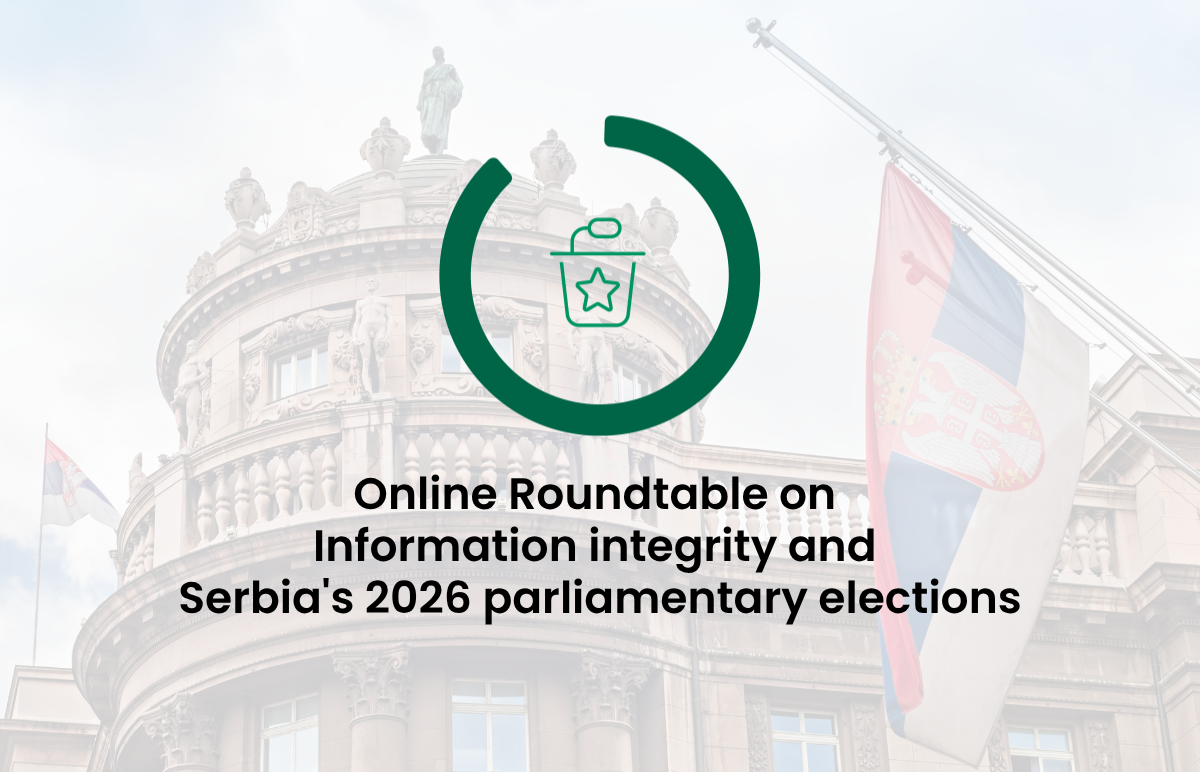
The European Fact-Checking Standards Network (EFCSN) is organising an online roundtable on the state of information integrity in Serbia ahead of the country’s parliamentary elections, in partnership with Istinomer, FakeNews Tragač, RasKRIKavanje, and AFP Serbia.
The details:
Date: Tuesday, 13 October 2026
Time: 14:00-15:00 CET
Format: Online, 60 minutes
Why Serbia’s elections matter for information integrity
Serbia has seen sustained mass protests since the collapse of the railway station canopy in Novi Sad in November 2024. More than a year and a half on, tensions within the country remain high and public debate has become increasingly polarised. In this climate, the working environment for fact-checkers has become markedly more difficult.
Election periods are consistently a focal point for information manipulation and coordinated influence efforts, and the days after a vote are often as decisive as the campaign itself. With parliamentary elections due on 25 October 2026, the integrity of the information space will be critical to a free and informed vote.
The roundtable will provide firsthand insights from EFCSN’s Serbian members about the information environment in the run-up to the elections. It will surface what Serbian fact-checkers are seeing, monitoring and reporting on in real time, connect that frontline insight with EU institutional stakeholders, and open a discussion on the post-election period and what comes next.
The session is open to representatives of the EU institutions, journalists, civil society organisations and other interested stakeholders; discussions are on the record.
This roundtable is organised as part of EFCSN’s work on election integrity and information manipulation in Europe.

Co-funded by the European Union. Views and opinions expressed are however those of the author(s) only and do not necessarily reflect those of the European Union or European Education and Culture Executive Agency (EACEA). Neither the European Union nor the granting authority can be held responsible for them.